


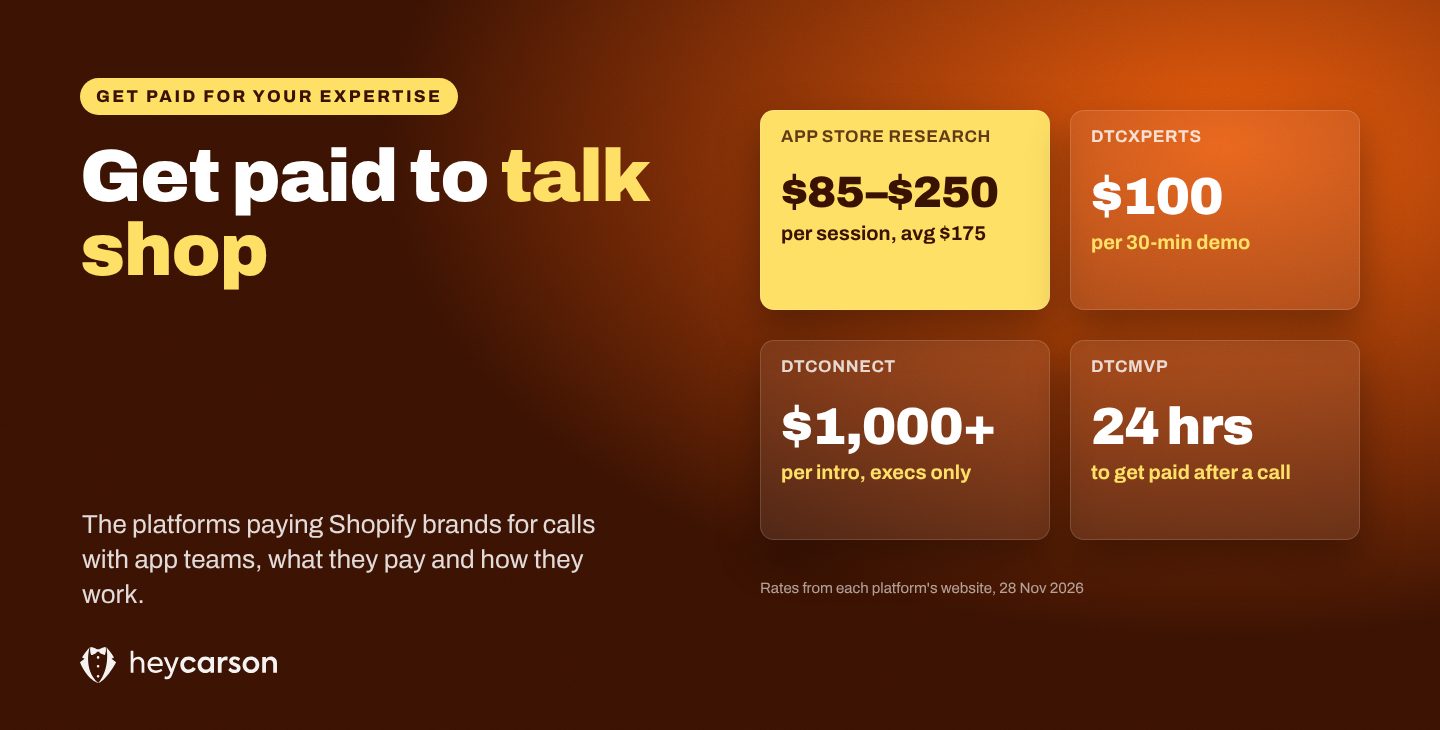
Shopify app teams have a problem: the brands they most want to talk to are the busiest people in ecommerce. So a growing number of them have stopped cold-emailing and started paying instead. Through a new wave of platforms, Shopify founders and operators now get paid $85 to $250 for a typical 30 to 60 minute call with an app team, and senior leaders at bigger brands get $1,000 or more.
The money is the headline. The better part: every one of these calls is a free look at new tools before your competitors find them, and a conversation with people who talk to hundreds of Shopify brands a month.
Do this next:
- Pick one Shopify-specific platform from the table below and apply; approval usually takes a few days.
- Write down three tools you'd like to see improved, so you know which calls to accept.
- Read the payout rules (fees, minimums, no-show policy) before your first call.
Disclosure: App Store Research is owned by HeyCarson, and the author of this article is its founder. We've ranked it first because we know it best, and we've included its fees and its critical reviews. Every figure for every platform below comes from its own website or public reviews, checked on 28 November 2026.
Why do Shopify app teams pay brands for calls?
The old way of selling to Shopify brands was cold outreach: emails, LinkedIn messages and conference booths. It doesn't work well on busy founders, and it's expensive. One of these platforms puts the alternative bluntly on its homepage: "Nobody values your time. Every vendor wants an hour of it. None of them have ever offered to cover it."
Paying for the meeting flips that. On the Honest Ecommerce podcast in May 2026, dtcmvp's founder Sean Wendt explained the shift: "The constraint is not budget. It is bandwidth," and "the vendors still winning on outreach are the ones who changed the offer, not just the personalization" (Honest Ecommerce). dtcmvp alone says it runs over 600 meetings a month (Cal.com case study).
For app teams, a paid call with the right brand is cheaper than a sales hire, and the feedback shapes their product. For brands, it's paid time, early access to new tools and free advice.
Which platforms pay Shopify brands for calls?
This table compares what each platform pays per call, who it's for and how it pays you, as of 28 November 2026.
| Platform | Pay per call | Who it's for | Paid via |
|---|---|---|---|
$85–$250, average $175 |
Shopify brand operators |
Bank, Wise, PayPal |
|
Not published |
Established Shopify brands |
PayPal, Amazon gift card |
|
$100 per 30 minutes |
Operators at $1M+ brands |
Bank via Stripe |
|
$1,000 minimum |
Executives at $25M+ brands |
Payment link |
|
Varies; $75–$150 seen |
Anyone who qualifies |
Digital gift cards |
|
Mostly $50–$250 |
B2B professionals |
Tremendous |
Call formats differ: research and feedback calls on App Store Research and dtcmvp, 30-minute demos on DTCXperts, and warm intros on DTConnect. The sections below explain each one.
1. App Store Research: best overall for Shopify brands
App Store Research connects Shopify app teams (and teams building themes and services) with vetted Shopify brand operators and agency staff for one-on-one video calls. It's built only for the Shopify ecosystem, which is why the calls tend to be relevant: if you're matched with a retention app, it's because you run retention at a Shopify brand.
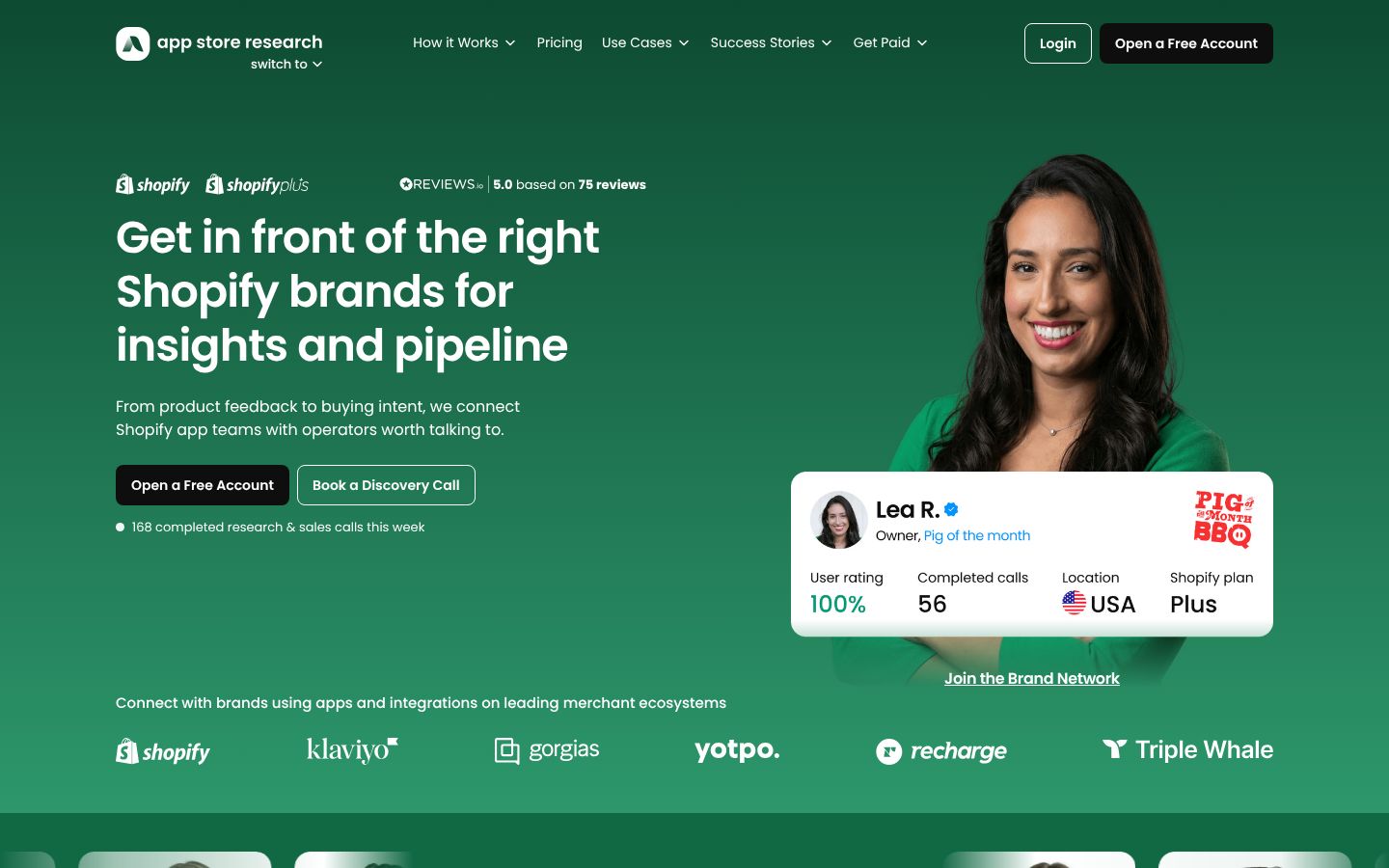
How it works for brands:
- Apply with your role and the Shopify brand you work at. Founders, heads of ecommerce, growth, retention and CRM leads, COOs, CTOs, merchandisers, marketers and CFOs all qualify, plus agency staff. Every participant is vetted manually.
- Get invited to projects that match your profile. Each invite shows the topic, length and payout.
- Pick the calls you want. You can decline anything.
- Take the call, usually 30 to 60 minutes on video.
- Get paid. The incentive is credited 2 to 5 business days after attendance is confirmed, and you request a payout once your balance reaches $150.
What you earn: the site says "$85 to $250 per interview, and sometimes more," with an average payout of $175 and some sessions up to $500. A sponsored newsletter listing showed real examples: a 30-minute call with brands using Klaviyo (see our email marketing app rankings) for $100, 45 minutes with CRO professionals for $150, and 30 minutes with merchants using cashback apps for $250. Referrals pay $50, or $100 if you refer a Shopify Plus brand.
What the calls are like: closer to a "founder coffee chat" than a sales demo, according to the site. You talk about your workflows, the tools you use, what breaks as you grow, and your reaction to a product or idea. Both sides review each other after the call.
How it works for app teams: research calls start at $150 per completed call (for example, a $100 incentive plus a $65 recruitment fee) and sales calls from $500. App teams only pay for calls that happen, with no charge for no-shows. Teams listed on the site include Loox, Recart, Supermoon, MobiLoud, Tresl and ClickPost.
The fine print: a 10% admin fee applies to payouts, and the minimum payout balance is $150. One reviewer on reviews.io didn't like it: "If I'm offered $X amount for a meeting, that's what I should be getting, not that minus a 10% admin fee." Missing a call without notice can get you removed from the panel.
What people say: 5.0 from 75 reviews on reviews.io and 4.0 from 15 reviews on Trustpilot. One merchant called it "the best use of 30 minutes"; another said, "I love discovering new tools and being able to influence them." Critical reviews mention not being selected for projects, which is the nature of matching: invites depend on what app teams are researching that month.
Best for: any Shopify founder or operator who wants regular, relevant calls with clear, published pay.
2. dtcmvp: the established network for bigger brands
dtcmvp calls itself "dtc's modern expert network." It's a managed service, run by Sean Wendt (Postscript's first employee, per Honest Ecommerce), that sets up paid meetings between established Shopify brands and technology partners.
How it works for brands:
- Apply or get invited. Membership is invite-based, but you can apply by emailing your LinkedIn and website. Every applicant is vetted. It's free to join.
- Get matched with technology partners relevant to your brand.
- Take the feedback call. dtcmvp holds the payment until the meeting happens.
- Get paid within 24 hours of the call, by PayPal or Amazon gift card. There's no cap on how many meetings you take.
What you earn: dtcmvp doesn't publish a per-meeting rate. It says it has paid members over $1M across 5,000+ meetings.
What the calls are like: brands aren't asked to grade whether a product is good. They explain where it might fit: their roadmap for the quarter, how they evaluate tools, and what a test would take. In practice that's closer to sales discovery than pure research.
Who uses it: brands shown on the site include Grüns, BYLT Basics, Kosas, Dagne Dover, Kith and Cuts. On the vendor side, it lists Postscript, Intelligems, OpenBorder, Depict and Storetasker, among others. Vendors pay a monthly subscription quoted per client.
Best for: operators at well-known DTC brands who want a steady stream of meetings and are comfortable with unpublished rates.
3. DTCXperts: simple flat rate for $1M+ brands
DTCXperts (note the spelling; the similar dtcexperts.com is a parked domain) is "the modern expert network for eCommerce." It's the simplest model of the four: one flat rate, one call format.
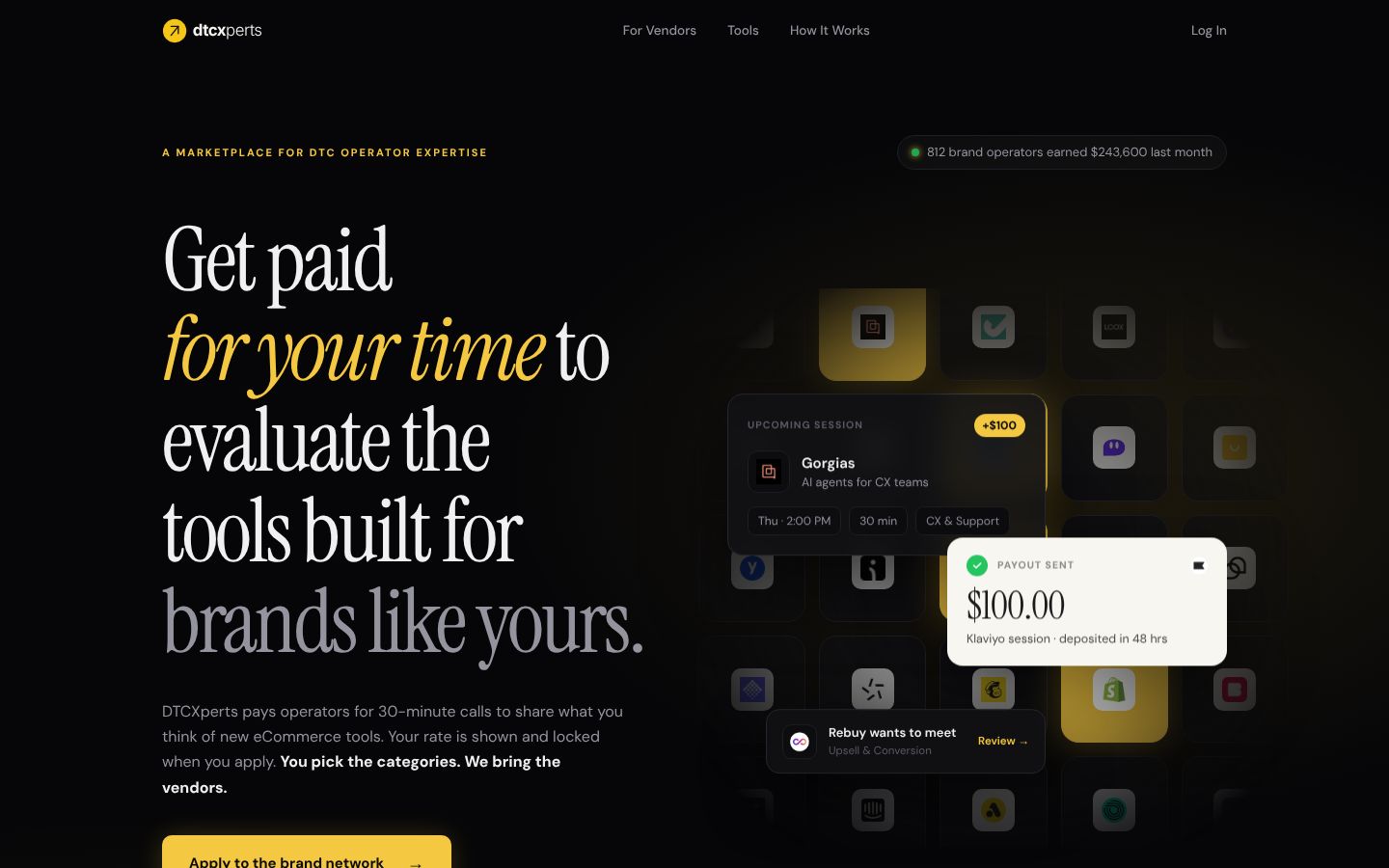
How it works for brands:
- Apply if you're a director, VP, head of ecommerce, CX leader or founder at a DTC brand doing $1M+ in revenue, and you influence tool decisions. Approval takes up to 48 hours.
- Choose your categories from 11 (for example retention, CX, analytics).
- Get matched, starting within 72 hours, with prep material before each call.
- Take a 30-minute session: a product demo plus your feedback.
- Get paid $100 per completed session, to your bank via Stripe, within 48 hours.
What you earn: $100 per session, the rate locked when you apply. It says operators typically do 2 to 4 sessions a month with no cap, and there's a $100 referral bonus.
How it works for vendors: credits per completed meeting, with no minimums or contracts, and filters by revenue band, role and tech stack. Its vendor price isn't clearly published.
What we couldn't verify: the site doesn't name its owners, and its testimonials couldn't be traced to real people, so we haven't quoted them. Treat it as newer and less proven than the first two.
Best for: operators who want a predictable $100 per demo with fast payment.
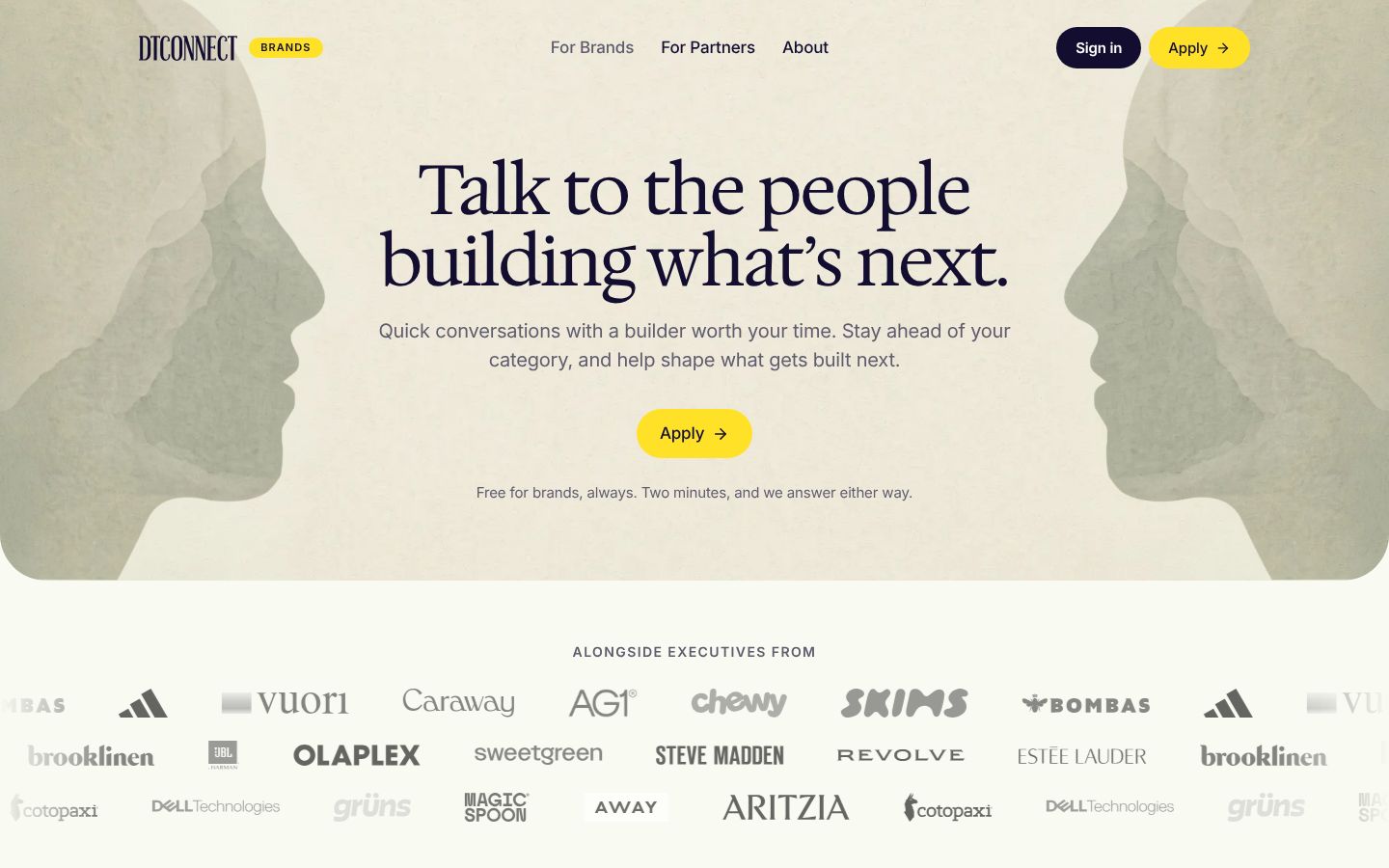
4. DTConnect: premium intros for executives at bigger brands
DTConnect is "a vetted, compensated warm-intro network for commerce," run by Down to Connect Inc. It's the premium end of the market: higher pay, bigger brands, fewer calls.
How it works for brands:
- Get invited. Applications need a referral or an invite from the founding team. It targets CEOs, founders, CMOs, CTOs, CFOs and VPs at brands doing $25M to $500M+ in apparel, beauty, CPG, supplements, home, pet and DTC.
- Receive a request by email, with who the partner is and exactly what you'd be paid. No login, no calendar access.
- Accept or decline in one click. Declining has no penalty and is "never traced to you."
- Take the call. A DTConnect operator approves every match by hand.
- Submit feedback and you're emailed a payment link. No invoice.
What you earn: "$1,000 USD... The floor, not the average," scaling with seniority. One example on the site is a $1,200 intro to an SMS marketing partner. The site describes calls as "an hour, minimum" in one place and shows a 30-minute request in another, so check each invite.
How it works for vendors: DTConnect works as a revenue partner rather than charging per meeting. Partners quoted on its site include PostPilot ("We've closed dozens of large opportunities through the connections DTConnect has made"), Passport and AfterSell by ROKT.
Best for: senior leaders at larger brands whose time is genuinely expensive.
Where else can you get paid for your expertise?
- User Interviews is a general research panel that says participants have earned $60 million. It regularly lists Shopify studies; two we found paid $150 for 30 minutes on how merchants vet apps, and $75 for 45 minutes testing for Shopify stores, both in digital gift cards.
- Respondent is a general B2B panel: "Most sessions pay $50–$250," and "Senior B2B roles regularly pay $400+." It isn't ecommerce-specific, so expect fewer relevant studies.
- Shopify itself runs paid research sessions with merchants; participants choose a thank-you gift from Shopify merchants. Keep an eye on your admin and email for invites.
- General expert networks like GLG let experts set their own rates, but they mostly serve investors and consultants, not app teams.
What do you get from these calls besides the money?
The fee is nice, but the information is often worth more.
You find the best new apps before everyone else. App teams on these platforms are usually testing something new or about to launch. You see tools before they show up in the "best apps" lists, like our SMS and subscription app rankings, and before your competitors do. One App Store Research participant put it simply: "I love discovering new tools and being able to influence them."
You get consulting you'd normally pay for. The people on the other side of the call talk to hundreds of Shopify brands. Ask them what they're seeing: what's working in retention this quarter, what conversion rates look like for brands your size, which integrations break most often. A good app team will answer, because they want you engaged. That's an hour of benchmark data and expert opinion, and you're the one being paid.
You shape the tools you'll use. Feedback from these calls is what app teams use to set their roadmaps. If your returns app is missing something, telling its product team directly is faster than a support ticket.
You build a network. Founders and product leads at app companies are well connected in the Shopify world. Those relationships can lead to beta access, partnerships and introductions.
You get a second opinion on AI tools. Many app teams are building AI features right now; a call is a cheap way to see what's real before you read our Shopify AI guide or set up Claude for your store.
You stay sharp on your own stack. Explaining why you chose your tools, and what frustrates you about them, is a useful audit in itself.
How do you get the most out of paid research calls?
- Be honest about your role and revenue. Platforms vet you, and app teams compare notes. Misrepresenting yourself is the fastest way to get removed, and unpaid.
- Only accept calls you're genuinely curious about. You'll give better feedback, get better ratings and get more invites.
- Prepare five minutes. Look at the app's website before the call and know what you'd want from a tool in that category.
- Bring your questions. Ask for benchmarks, roadmaps and what similar brands are doing. It's the most valuable part of the hour.
- Show up. No-shows get you dropped on most platforms. If you must cancel, give at least 24 hours' notice.
- Join two platforms, not six. Pick one Shopify-specific network and one higher-end one if you qualify. More sign-ups mostly means more emails.
- Keep records for tax, and if you're employed by a brand, check your employer's policy on paid outside calls.
Which platform should you join?
- You're a founder or operator at any size Shopify brand: start with App Store Research. Published pay, relevant calls, Shopify-only.
- You're at a well-known DTC brand and want volume: apply to dtcmvp too.
- You want a simple flat $100 per demo and your brand does $1M+: DTCXperts.
- You're an executive at a $25M+ brand: ask for an invite to DTConnect.
- You want occasional extra studies: User Interviews and Respondent.
And if you're on the other side, building a Shopify app: paying brands for their time is now the norm, not a gimmick. Our Shopify app rankings show how crowded most categories are, which is exactly why the teams that listen to merchants win.
Sources
Platform details, pay and rules were checked on each platform's own website on 28 November 2026: App Store Research, dtcmvp, DTCXperts, DTConnect, User Interviews and Respondent. Reviews from reviews.io and Trustpilot. Rates change often, so check each platform before you apply.





 Request to Join