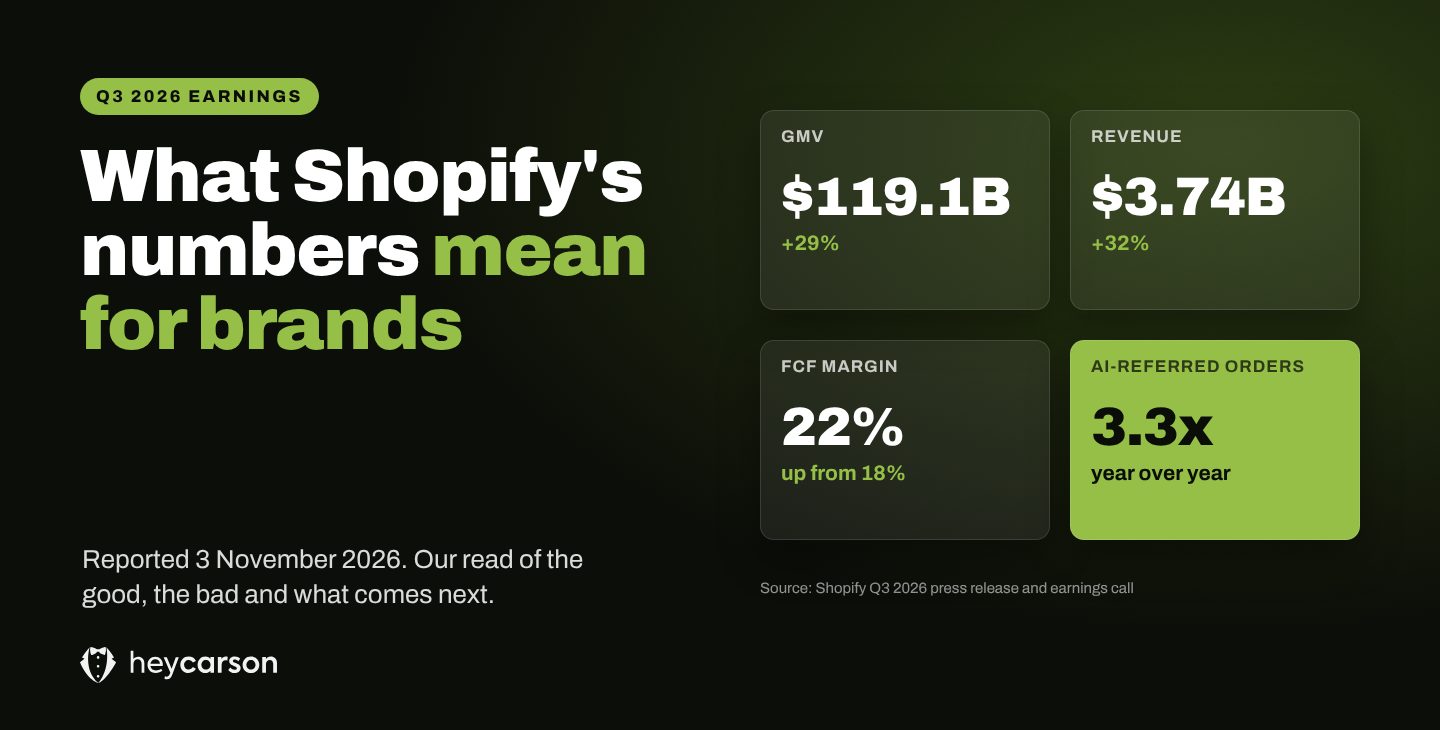
Shopify's Q3 2026 earnings, reported on 3 November 2026, show a platform that's still growing fast: $119.1 billion in GMV (up 29%), revenue of $3.74 billion (up 32%) and a 22% free cash flow margin. The stock still fell 8.7% on the day. For a brand selling on Shopify, the results say three things: the platform is winning share, AI shopping is real but small, and Shopify is leaning harder on payments, ads and its own Shop app to make money.
This is our read of the results from the merchant's side of the counter. The numbers come from Shopify's Q3 press release and 10-Q filing, and quotes from the earnings call. The opinions and predictions are ours, and we've labelled them. We build and fix Shopify stores for a living, so we care more about what this means for your store than for the share price.
Shopify Q3 2026 earnings at a glance
This table shows Shopify's headline Q3 2026 numbers against the same quarter of 2025, from the press release and 10-Q.
| Metric | Q3 2026 | Q3 2025 | Change |
|---|---|---|---|
GMV |
$119.1B |
$92.0B |
+29% |
Revenue |
$3.74B |
$2.84B |
+32% |
Merchant solutions revenue |
$2.91B |
$2.15B |
+35% |
Subscription solutions revenue |
$836M |
$699M |
+20% |
Operating income |
$568M |
$343M |
+66% |
Free cash flow margin |
22% |
18% |
+4 pts |
Shopify Payments share of GMV |
68% |
65% |
+3 pts |
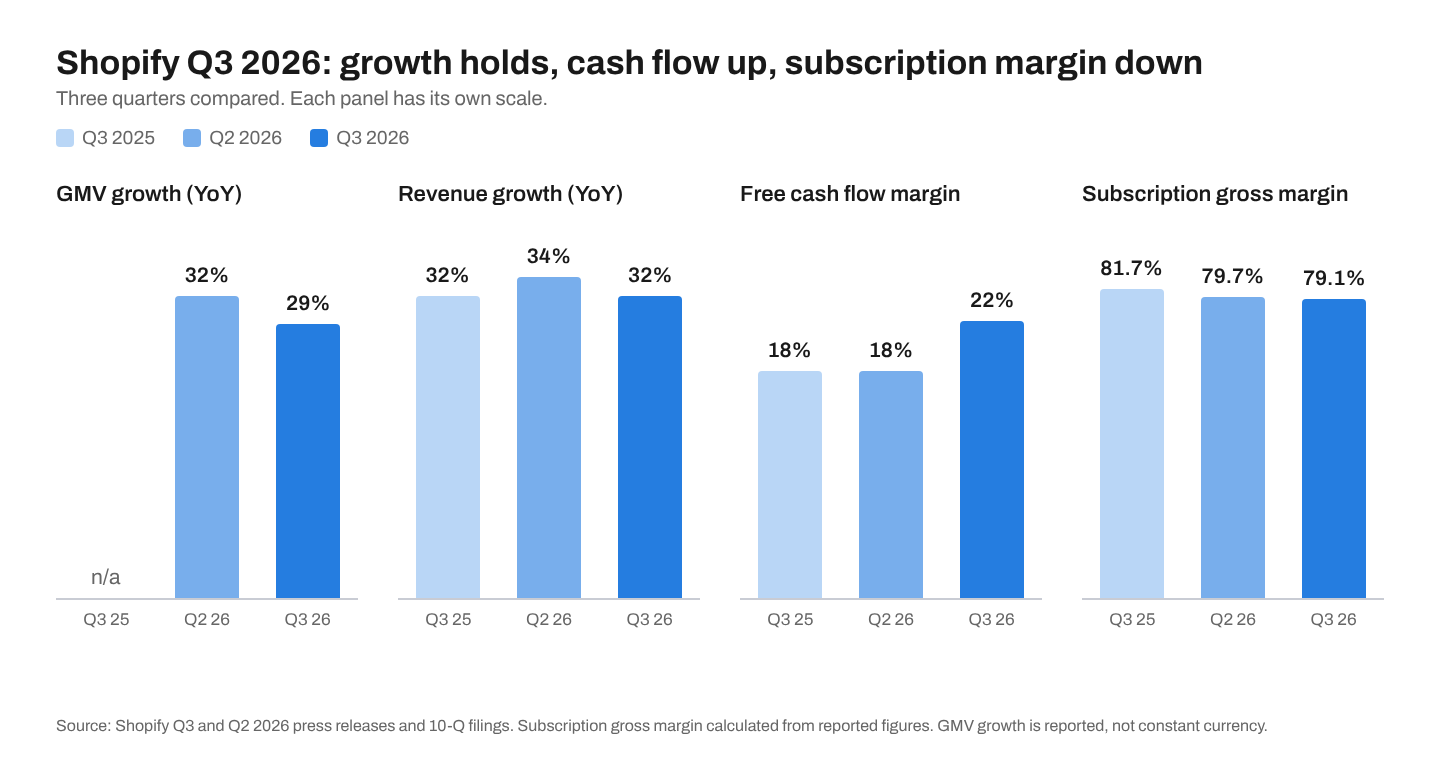
The trend lines matter more than one quarter. Revenue growth eased from 34% in Q2 to 32%, reported GMV growth slowed from 32% to 29% (30% at constant currency, the same as Q2), and the gross margin on subscriptions slipped for the third quarter running.
Shopify sells two things: subscriptions (your monthly plan, apps and themes it takes a cut of) and merchant solutions (payments, Shop Pay Installments, Capital loans, shipping, ads). Merchant solutions is now 78% of revenue. That split explains most of what follows.
The good news for brands
Shopify is taking share, and that protects your platform bet
On the call, Shopify said its merchants have captured "nearly half" of incremental US e-commerce since the start of 2025, and more than 40% in Europe. Its US merchants grew online sales at a 23% three-year compound rate, against 8% for US e-commerce overall. Growth was "evenly split among new and same-store sales", so existing stores are growing too, not just new signups.
Our take: this is the most important number for a brand. A platform that's gaining share keeps attracting app developers, theme designers, agencies, payment partners and AI channels. The ecosystem you rely on keeps getting investment. Replatforming away from Shopify got harder to justify this year, not easier.
AI shopping is growing fast and favours the long tail
Shopify gave the clearest AI numbers we've seen from any commerce platform:
- AI traffic to merchants is up 2.6x year over year, and AI-referred orders are up 3.3x.
- Shoppers from AI channels land on product pages 3x as often as from organic search, and convert 64% more often.
- Searches powered by Shopify Catalog convert at 2x the rate of general AI search.
- 74% of AI-referred sales came from product categories outside Shopify's top 100.
That last point is the good news for smaller brands. AI assistants aren't just sending orders to the biggest names; they're finding niche products. And when an AI channel sends a shopper to your Shopify store, CFO Jeff Hoffmeister said on the call that "the economics are exactly the same" for the merchant.
Our take: the volume is still small (Shopify's words), so don't rebuild your business around AI channels yet. But product data is now a growth lever. Clean titles, complete variants and accurate stock decide whether an assistant can recommend you. Our guide to Shopify agentic commerce covers what to fix first, and our agent-ready Shopify store guide covers the rest of your site.
B2B and retail are now real products
B2B GMV grew 74% and offline (point-of-sale) GMV grew 30%, with total locations on Shopify up 52%. Shopify named Canada Goose, The Body Shop, BevMo! (over 150 stores) and MAC Cosmetics as POS rollouts, and said 55% of merchants that added POS were new to Shopify.
Our take: if you sell wholesale or run shops, Shopify is no longer the "online only" choice that needs bolting onto a separate wholesale or retail system. Horizon themes now include volume pricing and quick order lists for B2B. Check our rankings of Shopify wholesale and B2B apps before you pay for one, because some of what they do is now built in.
Sidekick is getting used, and it's getting cheaper to run
Daily active merchants using Sidekick are up 3.7x year over year, and Shopify said Sidekick created about two thirds of all Shopify Flow automations. Shopify also measured an 8% lift in new merchants reaching five sales within 15 days when guided by Sidekick. From Q2 to Q3, cost per Sidekick conversation fell 28%.
Our take: Sidekick has gone from novelty to a tool most merchants should use weekly, especially for Flow automations and reports. Our Shopify Sidekick guide has prompts that work. And Canvas, the new AI store design surface, launched in October; Shopify said merchants using it launch stores 20% faster.
The bad news, or at least the things that worry us
AI is squeezing Shopify's subscription margins
Subscription gross margin fell to about 79% in Q3, from about 82% a year earlier. Hoffmeister said it "compressed primarily from incremental AI spend on Sidekick", and the 10-Q shows a $40 million rise in infrastructure costs including "LLM usage costs".
Our take, and this is speculation: Shopify is giving away an expensive AI assistant inside a monthly plan whose price hasn't moved. That can't last forever. We'd expect one of three things in 2027: a plan price rise, usage limits on Sidekick or Canvas with paid top-ups, or AI features moved into higher plans. Budget for a higher Shopify bill next year, and don't build a workflow that depends on unlimited Sidekick use.
Payments savings go to Shopify, not to you
Shopify Payments now processes 68% of all GMV ($81.4 billion this quarter). Merchant solutions gross margin expanded for the third quarter in a row, which Shopify credited to "savings negotiated with partners across the full payments ecosystem". Nothing in the results passes those savings on as lower rates for merchants.
Our take: this is how platforms work, but it's worth knowing. Shopify's growth increasingly comes from a cut of every sale, not your plan fee. Your effective card rate is worth checking once a year against what you'd pay elsewhere. Higher payments penetration also means more of your business runs through one provider, so read the terms on reserves and payouts.
Shopify is becoming an ad platform and a marketplace
Merchant solutions revenue now includes advertising on the Shopify App Store and Shop Campaigns, which reaches "10 channels from Shop to Instagram to ChatGPT". Shop app GMV more than doubled year over year, Shopify paid about $100 million (per an analyst's question on the call) to move Shop to shop.com, and Shop Pay can now be used as a wallet for any merchant in some AI agents, including merchants not on Shopify.
Our take, partly speculation: Shopify is building a consumer brand that sits between you and your customer. That's useful for reach (Shop Campaigns only charges when a sale happens), but every order that starts in Shop, in an AI agent or with "delegated purchasing through personal agents" (which Shopify said shoppers began testing in Q3) is an order where you don't own the first touch. Treat Shop and AI agents as channels, like a marketplace, and keep investing in the things that bring customers to you directly: email, your brand, and repeat purchase.
The stock fell, and Wall Street wants more
Shares fell 8.74% on results day. CNBC tied the drop to subscription gross profit and GMV coming in below estimates, and Yahoo Finance reported revenue missed consensus for the first time since 2022, though by less than $10 million ($3.742 billion against $3.75 billion).
Our take, speculation: a public company that misses on subscription profit tends to respond by raising prices or finding new fees. Combined with rising AI costs, that's another reason we expect Shopify's take from merchants to grow in 2027, through plans, payments or ads.
What we expect from Shopify in 2027
These are predictions, not announcements:
- AI gets priced. Some form of Sidekick or Canvas usage pricing, or a plan price rise, before the end of 2027.
- More checkout happens off your site. Shopify is investing in agent checkout (the Universal Commerce Protocol and Shop Pay as a wallet inside AI agents). Expect more of your orders to start somewhere else.
- Shop becomes a bigger ad channel. Shop Campaigns orders more than doubled this year. Expect more placements and more pressure to use them.
- International gets easier. Shopify flagged WhatsApp sign-in and messaging, local currency billing in 10 more countries, OXXO cash payments in Mexico and Shop Pay Installments in Australia, and promised "a lot more of this to come in 2027."
- Enterprise brands keep arriving. Shopify named Balmain, MAC, Clinique, Givenchy, Jacquemus and Acne Studios as new or expanding. The biggest merchants ($25 million+ in GMV) are its fastest-growing band, which means more enterprise features and more competition for attention in the app and agency ecosystem.
What brands on Shopify should do now
- Fix your product data for AI channels. Titles, variants, images and stock accuracy. Check your status in Sales channels > Agentic and follow our agentic commerce checklist.
- Use Sidekick for the boring work (reports, Flow automations, bulk edits) while it's included in your plan.
- Check your effective payments rate once a year, including Shop Pay Installments and currency conversion fees.
- Test Shop Campaigns with a capped budget if you sell to repeat buyers; it's pay-per-sale, so the risk is limited.
- Own your customer relationship. Every channel that sits between you and the shopper makes email capture and repeat purchase more valuable, not less.
- Budget for a higher Shopify bill in 2027, in case our prediction is right.
Shopify president Harley Finkelstein talked through the quarter on CNBC in November 2026, including how fast shopping through AI channels is growing:
Video: "Shopify president Harley Finkelstein: Shopping through AI channels is 'growing quite quickly'" by CNBC Television.
If you want help acting on any of this, from product data for AI channels to a B2B or POS rollout, you can brief a vetted Shopify expert.
Related guides: